

BG Titan Report 2026: Securing AI Infrastructure Is Now a National Priority Countries Can't Afford to Lose
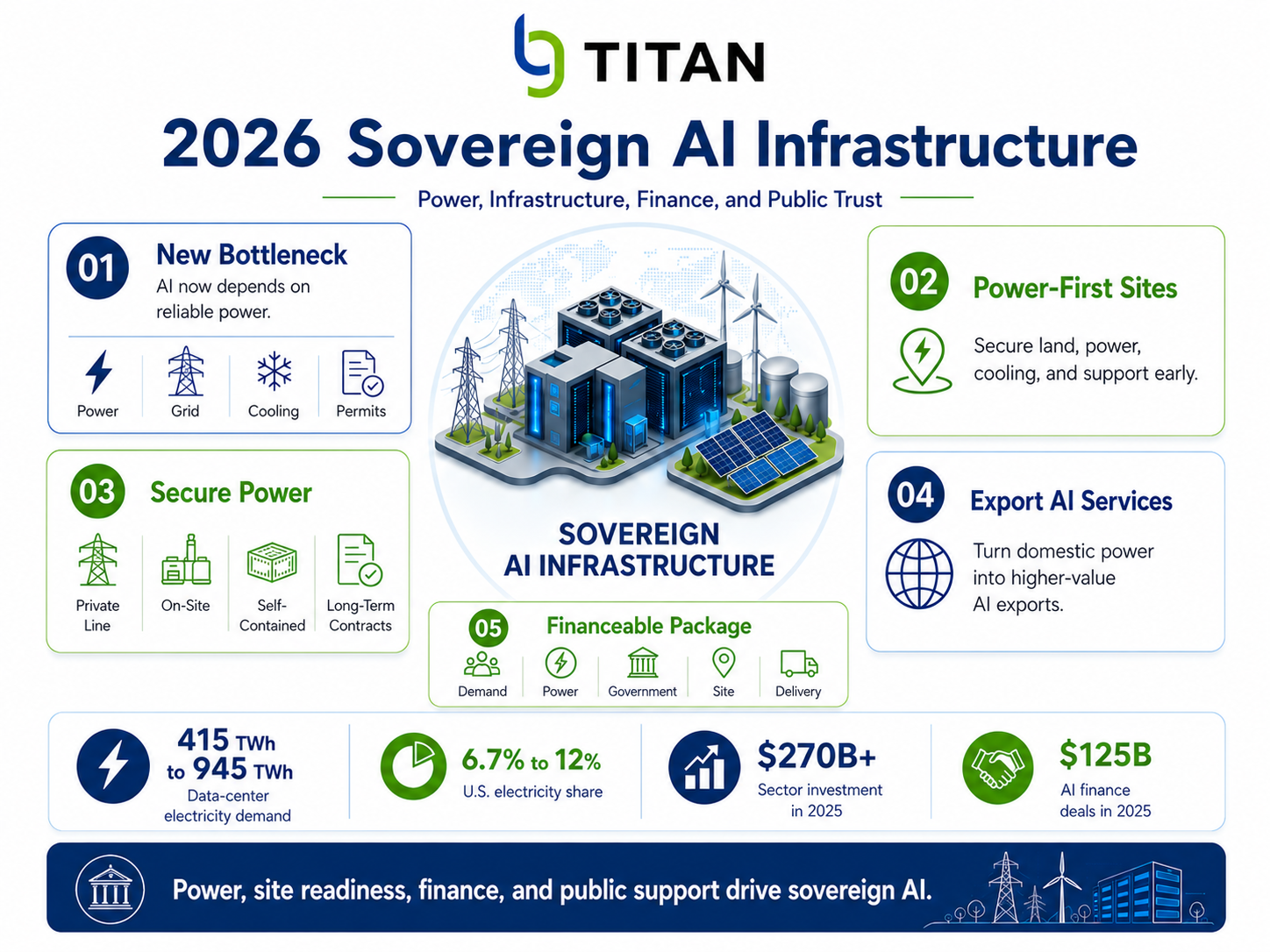
BG Titan's 2026 Sovereign AI Infrastructure report: power, finance, and public trust now decide who scales AI capacity.
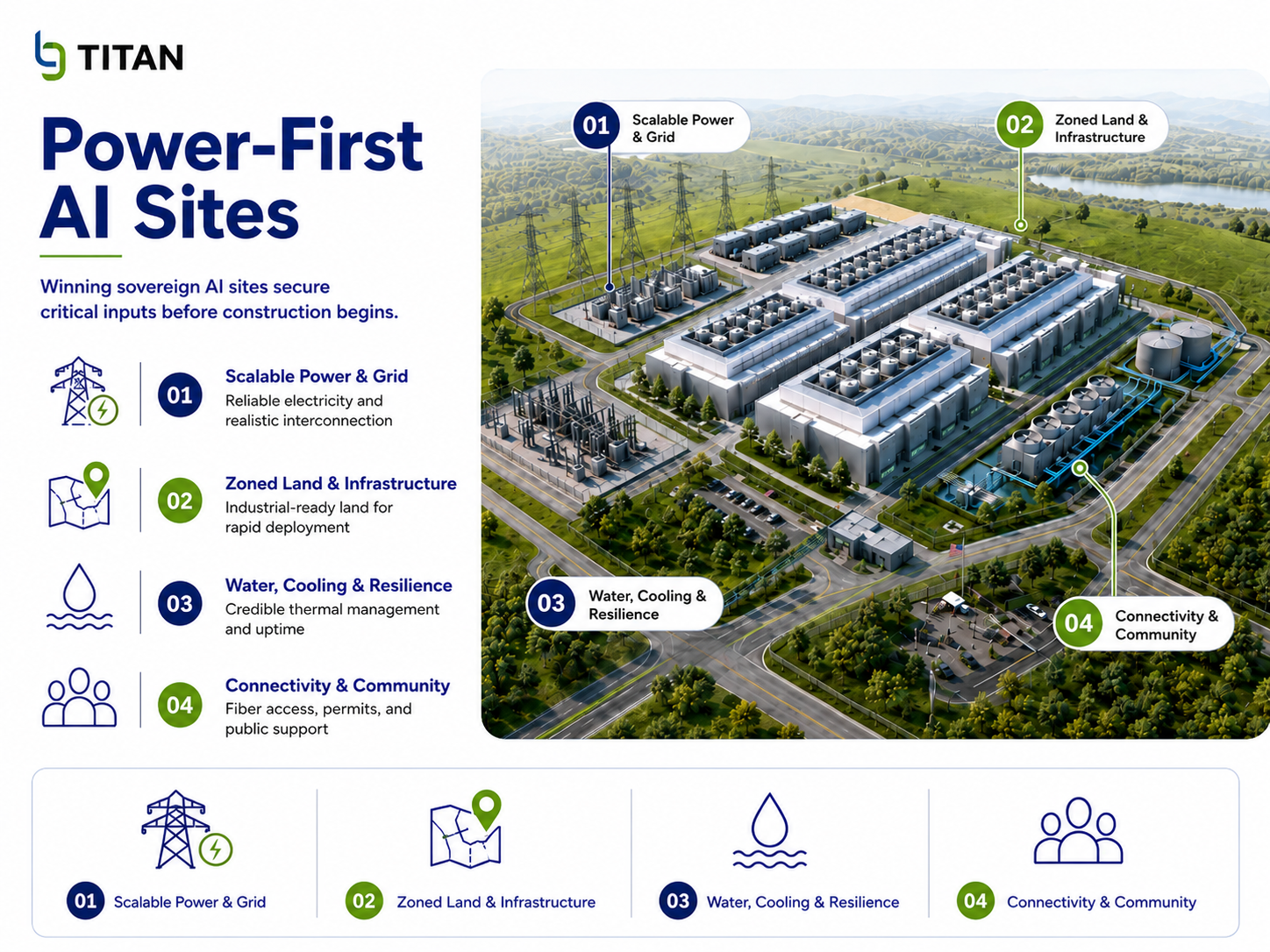
BG Titan: winning sovereign AI sites lock in power, land, cooling, and community support before construction begins.
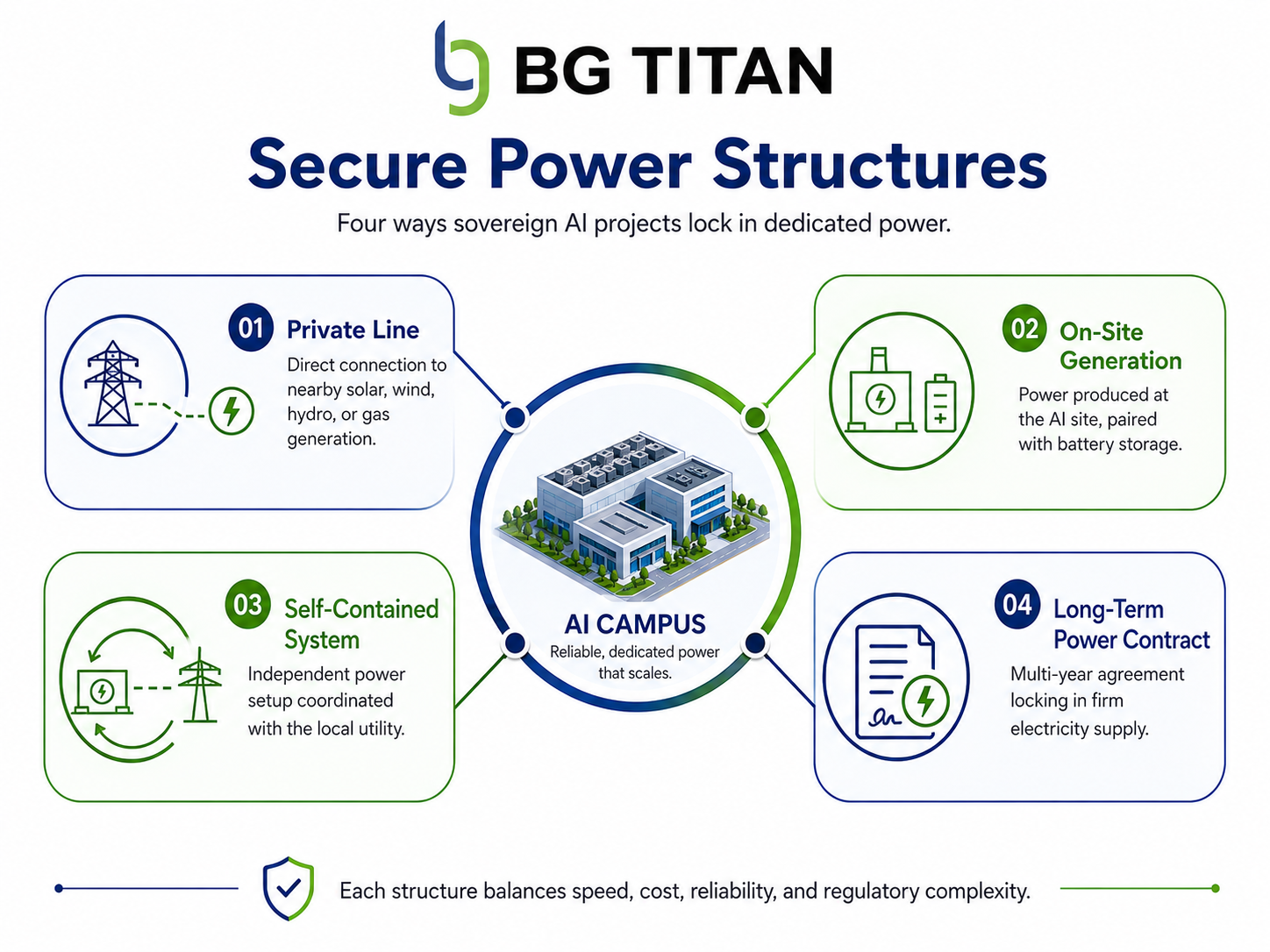
BG Titan: four ways sovereign AI projects secure dedicated power, each balancing speed, cost, and reliability.
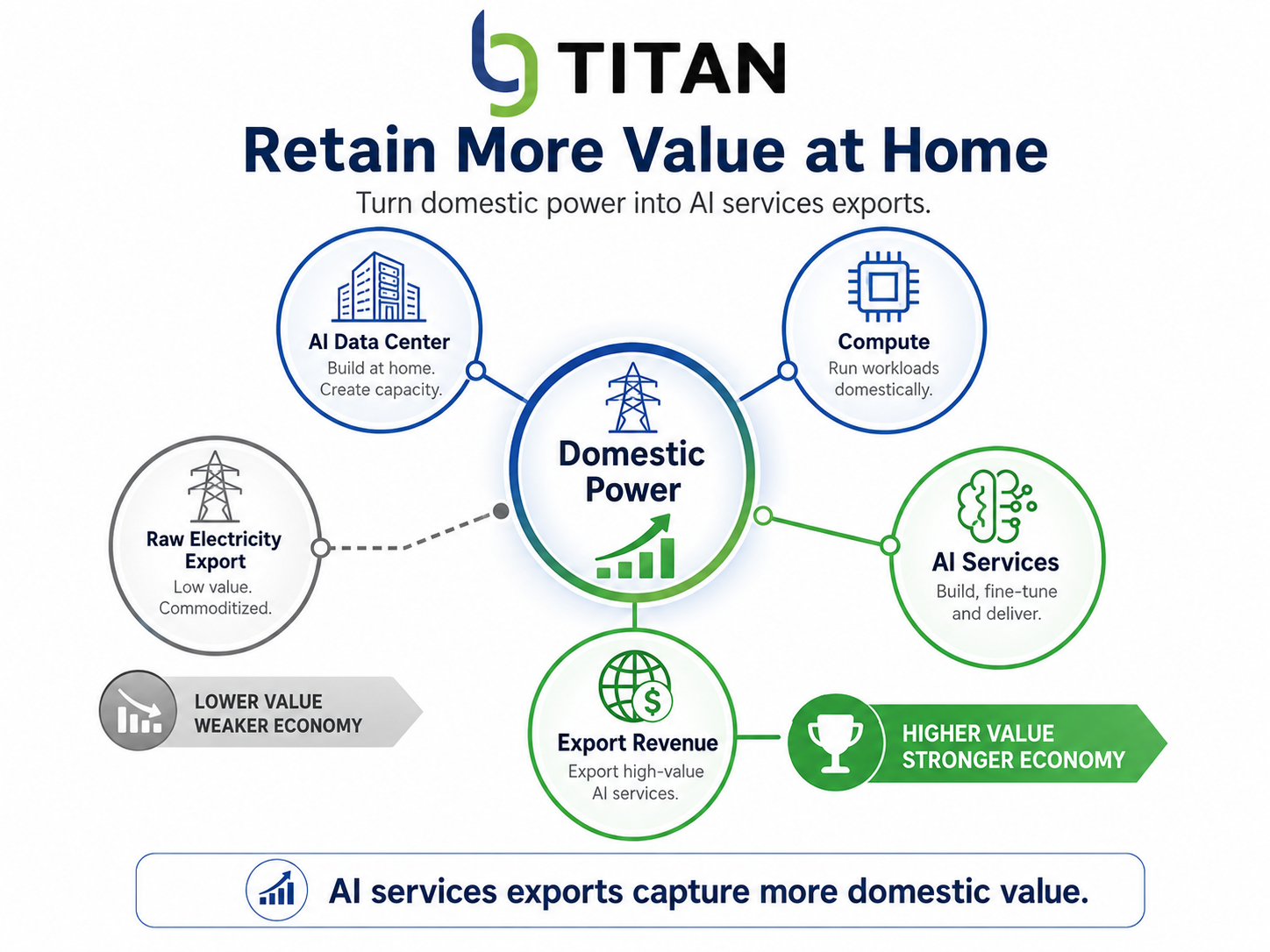
BG Titan: energy-rich nations capture more value by exporting AI services, not raw electricity.
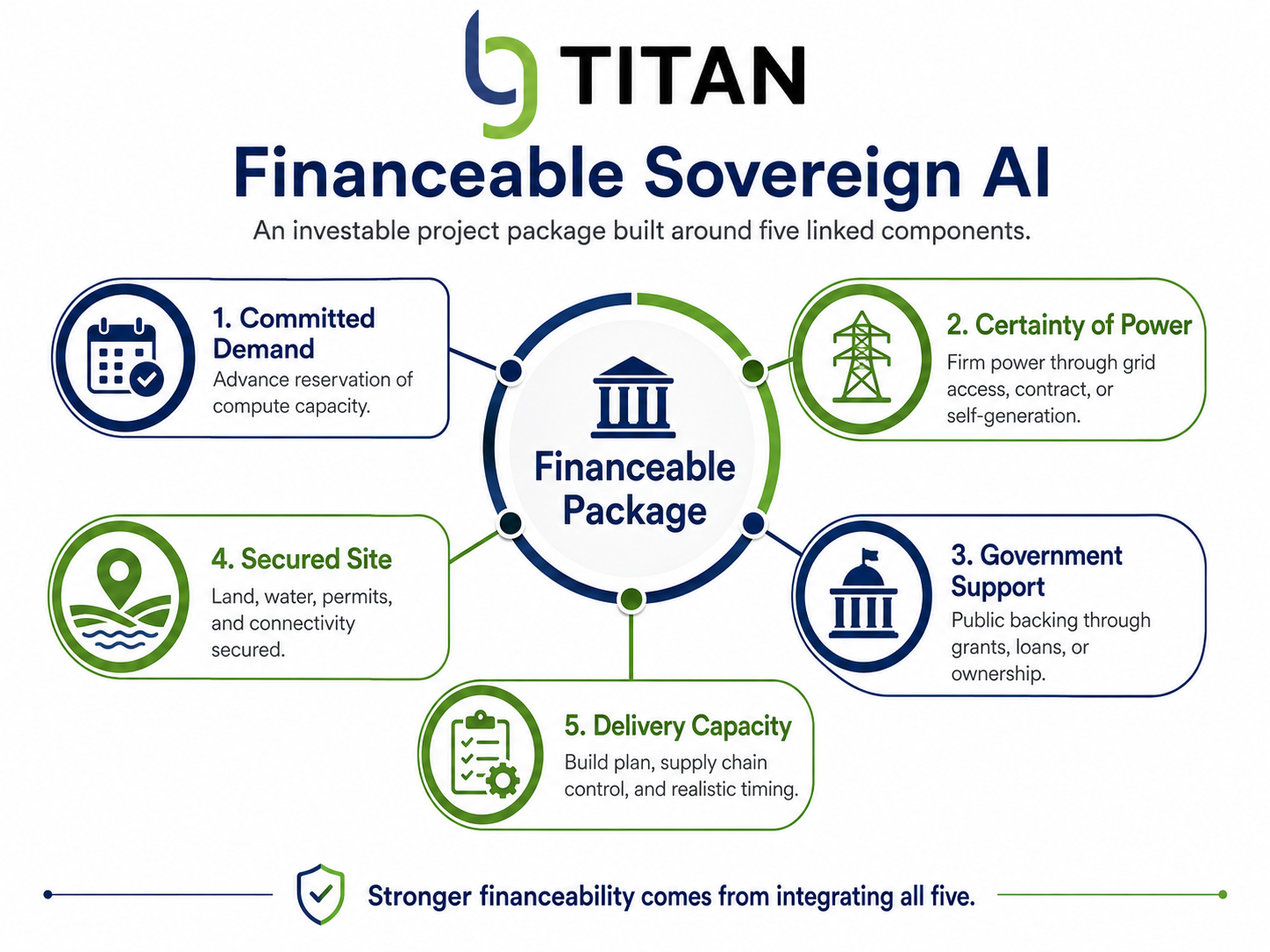
BG Titan: five linked components, demand, power, government support, site, and delivery, make sovereign AI financeable.
BG Titan's 2026 report argues AI infrastructure is now as vital to national strength as energy itself, and explains what it takes to build and finance it
SAN DIEGO, CA, UNITED STATES, June 3, 2026 /EINPresswire.com/ -- BG Titan Group today released its 2026 Sovereign AI Infrastructure Report, and its central message is direct: building the computing power behind AI is no longer just a technology project, it has become a national priority. The report finds that the countries and investors moving ahead are those that can convert reliable energy into AI capacity that is financeable, well governed, and supported by the public, rather than those that simply secure the latest hardware.
The report's core finding is that AI now depends on electricity more than on chips. For years, the assumed bottleneck was access to advanced processors. Today the harder constraint is firm, reliable power, together with everything that has to accompany it: a grid connection, permits, cooling, industrial land, financing, and public consent. BG Titan describes this combination as the true limiting factor and argues that AI computing should now be treated as strategic national capacity, in the same category as the generation, transmission, and industrial assets governments have always regarded as essential.
The strongest projects, the report finds, secure their resources before construction begins rather than after. A winning site pairs firm power that can expand over time with land already zoned for industrial use, available capacity on the local grid, credible water and cooling plans, high-capacity connectivity, and community support, all locked in ahead of demand. BG Titan calls this a power-first approach, and it reverses the usual sequence. Too often a large AI project is announced first and the electricity to run it is sourced afterward. The report argues that projects which establish power, grid access, and public consent up front are far more likely to be delivered on schedule and at a cost of capital that lenders will accept.
Because reliable, dedicated power is so decisive, the report examines in detail how projects can obtain it. It sets out several structures. A site can run a direct private line to a nearby solar, wind, or gas plant. It can generate power on site and pair it with battery storage. It can operate as a self-contained system that still coordinates with the local utility. Or it can sign long-term contracts that lock in firm electricity for years. Each option carries its own balance of speed, cost, and risk, and the report stresses that the right choice depends on the jurisdiction, the available energy resources, and the risk tolerance of the parties involved.
BG Titan also makes a point that matters for energy-rich nations. Rather than exporting raw electricity across a border, a country can use that power domestically to run AI services and export the services instead, retaining far more of the economic value at home. The report points to working examples in the Gulf, where governments are backing large state-supported AI platforms, and in the Nordic countries, where abundant hydropower is already being put to use. It notes parallel efforts underway across Canada, Europe, the United Arab Emirates, and Saudi Arabia, and adds that developing economies can participate where power, connectivity, and development financing align.
The report is candid about what can derail a project. Congested power grids, long waits to connect new load, water use, the risk of raising electricity bills for households, and local opposition can each stall a development or erode its public standing. For that reason, BG Titan treats public acceptance as part of the investment case itself, not as a downstream communications exercise. The report notes that the electricity AI consumes has become a political issue tied to affordability, so a project that disregards its impact on local residents can be delayed regardless of how strong it appears on paper. It is equally frank that the underlying power choices involve genuine tradeoffs: gas can be built quickly but carries carbon emissions and exposure to fuel prices, while clean energy requires storage and backup to deliver the steady output that AI computing demands.
BG Titan's central recommendation is to structure a sovereign AI project as a single, financeable package rather than a stand-alone computing build, organized around five components. The first is committed demand, in the form of a tenant or buyer who reserves the computing capacity in advance. The second is certainty of power, established through a place in the grid connection queue, a long-term supply contract, or self-generation with backup. The third is government support, whether grants, low-cost loans, or a strategic ownership stake. The fourth is a secured site, with control of the land, a water plan, permits, and connectivity in place. The fifth is the capacity to deliver, meaning a credible construction plan, a managed supply chain, and a realistic schedule. Together, the report argues, these elements turn a promising location into an asset that traditional infrastructure investors can confidently underwrite.
The report also describes how BG Titan moves a project from concept to completion. It begins by identifying places where reliable power and genuine AI demand converge, then assembles the land, power, water, connectivity, permits, and customers into one coordinated package. From there it reduces risk by building evidence of community, regulatory, and counterparty support, then brings the parties together around a clear mandate for the project. BG Titan argues that this assembly work is what ultimately determines success, and that the players who can integrate the whole package will matter more than those who merely resell the computing hardware.
For all that momentum, the report is clear about the limits of the present moment. There is no single, proven model yet for how governments should award and structure these projects, and the financing and power arrangements will vary from country to country. The economics of dedicated power remain unsettled. Rather than offering a finished playbook, BG Titan presents its framework as a disciplined way to make decisions while this new market matures.
"Sovereign AI winners will be the jurisdictions that secure power, earn public trust, and structure compute as investable infrastructure rather than one-off technology procurement," said the Chief Executive Officer of BG Titan Group.
"The critical path is no longer GPU sourcing alone; it is the integrated package of firm power, land, permitting, cooling, connectivity, and execution control," said BG Titan Group's Technical Lead. "The actors who can package the platform will matter more than the actors who merely resell the hardware."
Selected data points
Data-center electricity demand rising from 415 TWh in 2024 to 945 TWh by 2030 (International Energy Agency, Energy and AI, 2025).
Data centers projected to reach a 6.7% to 12% share of U.S. electricity by 2028 (Lawrence Berkeley National Laboratory / U.S. Department of Energy, 2024 Report on U.S. Data Center Energy Use).
$270B+ in announced data-center sector investment in 2025 (UNCTAD, Global Investment Trends Monitor No. 50, January 2026).
$125B in 2025 AI data-center finance deal volume (as cited in BG Titan's 2026 Sovereign AI Infrastructure Report).
About BG Titan Group
BG Titan Group works globally at the intersection of infrastructure strategy, capital formation, and complex deal execution. The firm partners with governments, investors, and operators to originate, structure, and de-risk large-scale projects where energy, industrial policy, financing, and long-term development must move together.
Jamila Hasanova
BG TITAN GROUP
+1 332-301-4222
email us here
Legal Disclaimer:
EIN Presswire provides this news content "as is" without warranty of any kind. We do not accept any responsibility or liability for the accuracy, content, images, videos, licenses, completeness, legality, or reliability of the information contained in this article. If you have any complaints or copyright issues related to this article, kindly contact the author above.
